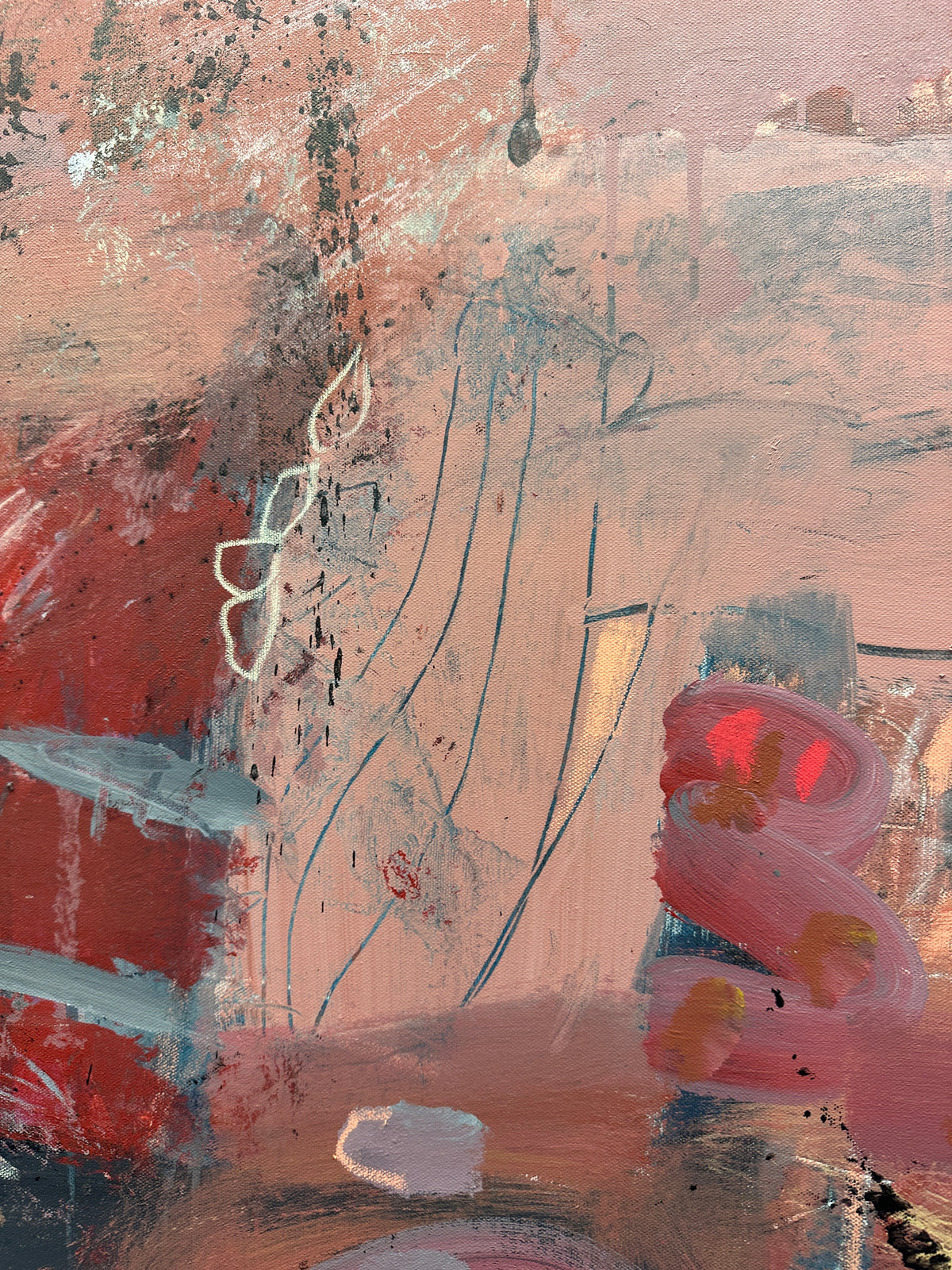
Garden of Experience by Kurtis Brand
Triptych, three panels 48" x 36" total size of 48" x 108"
Acrylic, oil pastel, and graphite on canvas
Three separate canvases. One field. The oxblood ground arrives at the edge of the first panel, crosses the gap, and continues. It does this twice. Nothing was stretched to make that happen. The color was laid down knowing the breaks were there, and the breaks became part of how it holds. That is the whole argument. Acceptance is what lets separate things belong together without being forced into one thing. The gaps stay gaps. The field stays whole. Rose, terracotta, and deep red carry all three panels, with grey and black massing through the middle of each.
The Garden of What Is
Enter from the left edge and the forms arrive one at a time. A stem. A leaf turned toward light. A cluster of mushrooms rising from dark ground. Each form marks a moment lived, and each grows from the one before it. Walk the full width of the canvas and the moments gather into a single picture: a life, seen whole.
The mushrooms are a precise choice. Fungi feed on what has fallen. They rise overnight from decay and return it to the soil as nourishment. In Kurt's iconography, plants and mushrooms stand for experience itself: what happens to us, taken in, broken down, and given back as growth. Loss composts. Difficulty becomes ground. The garden grows from everything that enters it.
What grows, in this garden, is acceptance.
Each step along the way ripens into the same recognition: life is what it is. Kurt names the subject of the painting plainly. Isness. What is. The canvas holds the world as it arrives, before it has been edited by wanting. In his words, the piece is without desire.
That phrase carries nearly twenty years of Zen practice. Kurt often quotes Sengcan, the Third Patriarch of Chan Buddhism, whose poem Faith in Mind opens with a line Kurt returns to again and again: "The Great Way is not difficult for those with no preferences." Preference is the gap between what is and what we want it to be. This painting closes the gap. Every form receives equal attention. The bright bloom and the small dark cap hold the same place in the composition, because they hold the same place in a life.
The painting also moves in both directions. Read it left to right and you follow a journey from first experience toward acceptance. Read it right to left and you begin in acceptance and walk back through the experiences that made it. Both readings hold. Memory works this way. So does practice. Understanding arrives at the end of a path, and then it illuminates every step that led there.
This is how Kurt works generally. His paintings are records of processes, built through layering, return, and response. The surface carries the evidence of its own making, the way a life carries the evidence of its living. The garden here is both image and method: the painting grew the way its subject grows, one encounter at a time, each mark answering the last.
Stand with it long enough and the composition settles. The eye stops searching for a center and begins to rest in the whole field. That shift is the teaching. A garden has no single correct flower. It has a season, a soil, a light, and everything those conditions produce.
Enjoy.